

Table of Contents
- How Grip Width and Handle Shape Change Your Cable Row
- Seated Cable Row Muscles Worked: Lats, Middle Back, and Biceps
- Attachment Types: V-Grip, Straight Bar, T-Bar, and Row Handles
- Neutral Grip Cable Row Benefits for Back Development
- How to Fix Wrist Pain During Cable Rows
- Fit, Compatibility, and Build Quality to Check Before You Buy
- Picking the Right Cable Row Attachment for Your Training Goal
- Frequently Asked Questions
Last Updated: October 8, 2026
How Grip Width and Handle Shape Change Your Cable Row
The best cable row attachments for back training let you pull with your lats instead of your hands, and that comes down to two variables: grip width and handle shape. This guide from The Delta Grip breaks down how each attachment type loads your back and which one fits your goal.
Grip width controls how much your lats stretch at the start of the pull and how hard they contract at the end.
Handle shape decides where your wrists sit during the pull. A fixed straight bar forces your wrists into whatever angle it dictates; a V-grip or rotating handle lets them stay neutral, which matters once the weight gets heavy.
Neutral, Overhand, and Underhand Grips Compared
A neutral grip, palms facing each other, keeps the wrist stacked over the forearm and reduces strain through the elbow. Overhand grips bias the upper back and rear delts; underhand grips bring the biceps and lower lats in more directly. Rotate between all three across a training block.
Tucked Elbows, Range of Motion, and Elbow Position
Tucked elbows keep the shoulder in a stronger position and let the lats drive the movement. Flared elbows turn a row into a rear-delt and trap exercise, fine if that's the goal, but not back development.
Range of motion matters just as much. A handle that's too wide or too rigid shortens the pull before the lats fully contract. An open frame design lets the handle travel through a natural arc instead of a fixed path.
Seated Cable Row Muscles Worked: Lats, Middle Back, and Biceps
The seated cable row muscles worked depend almost entirely on your grip and elbow path. A neutral, close grip hits the lats hardest; a wide overhand grip shifts emphasis to the rhomboids, traps, and rear delts. Biceps contribute on every variation, but how much depends on whether your palms face up, down, or in.
Latissimus Dorsi and Lower-Lat Emphasis
The latissimus dorsi runs from the armpit down to the lower spine, and the lower fibers respond best to a close, neutral grip with the elbows tucked tight to the ribs. A V-grip or close-grip row handle puts you there immediately. Pull to the lower abdomen, not the chest, to keep the lower lats engaged through the full range.
Middle-Back and Upper-Back Emphasis
Middle-back and upper-back emphasis comes from a wider grip and a higher pull path. A straight bar or T-bar attachment with an overhand grip drives the rhomboids and mid-traps harder, especially when you pull toward the sternum and squeeze at the top.
Neither variation is "better." They build different parts of the same chain.
Attachment Types: V-Grip, Straight Bar, T-Bar, and Row Handles
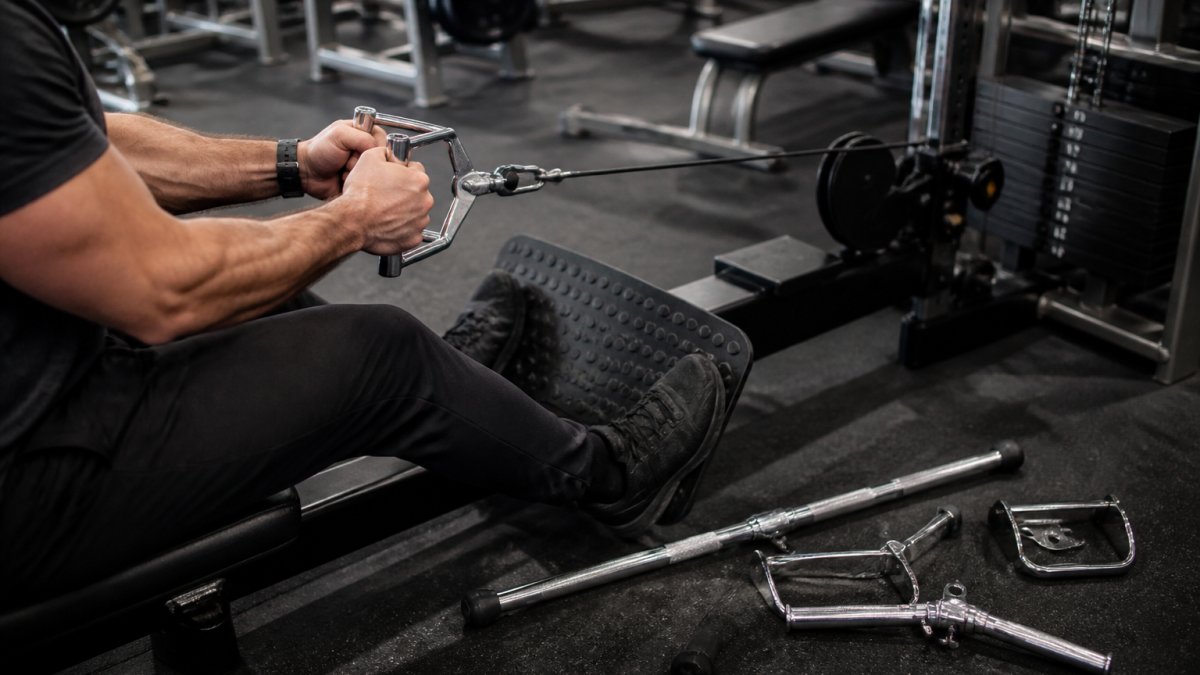
Every cable row attachment falls into one of four families, and each changes your mechanics predictably. V-grip and close-grip handles pull your hands together and keep the elbows tight.
| Attachment | Grip | Primary Emphasis | Best For |
|---|---|---|---|
| V-grip / close-grip | Neutral, narrow | Lats, lower lats | Lat width and thickness |
| Straight bar | Overhand or underhand, wide | Upper back, rhomboids | Mid-back thickness |
| T-bar attachment | Neutral, medium | Lats and mid-back | Heavy rowing with control |
| Single row handle | Neutral, one arm | Lats, unilateral balance | Fixing side-to-side gaps |
V-Grip and Close-Grip Row Handles
A V-grip handle is the default choice for lat-focused rowing. The neutral, close grip keeps the elbows tucked, shortens the lever arm at the shoulder, and lets most lifters pull more weight without wrist discomfort.
When you shop, the numbers that matter are measurable before you buy:
- Handle width: Most V-grip and close-grip row handles sit in the 5- to 8-inch range between the grips. Narrower than about 5 inches crowds the hands; wider than about 8 inches stops feeling like a close grip.
- Grip diameter: Standard cable attachments usually run about 1 to 1.25 inches thick. If your hands are small or you have grip limitations, a 1-inch handle is noticeably easier to hold than a 1.25-inch one over a long set.
- Connection point: Nearly all of these attach with a carabiner or snap hook through a welded ring or eyelet. Check the ring's inner diameter against your carabiner, a 1-inch ring paired with a 1.5-inch carabiner will rattle and shift mid-rep.
The limitation is variety. Run every row with a V-grip and you'll build the lats while leaving the upper back underdeveloped.
Straight-Bar and T-Bar Attachments
Straight-bar and T-bar attachments open the grip and shift work to the middle and upper back. A straight bar with an overhand grip is the classic choice for rhomboid and trap development. A T-bar attachment sits between the two, offering a medium-width neutral grip that works well for heavy rows.
Practical specs to compare:
- Straight bars commonly run 20 to 48 inches wide. For rows, a 20- to 28-inch bar is the useful range; anything wider turns the movement into a rear-delt pull rather than a back builder.
- T-bar attachments typically land around 10 to 14 inches between grips, with a neutral or angled grip. The angled version is easier on the wrists than a flat neutral bar.
- Grip surface: Knurled steel gives the most traction but can chew up your hands. Rubber or urethane coatings are gentler and still hold under sweat. A lightly knurled bar is the middle ground most home-gym owners prefer.
Both demand more wrist mobility than a V-grip. If your wrists complain, that's a signal, not a weakness to push through.
Single Row Handles
A single row handle is a one-arm attachment, usually a D-handle or a short neutral-grip handle with its own carabiner loop. It's the tool for unilateral work: one arm at a time, which exposes and corrects side-to-side strength gaps a two-handed bar can hide. Two specs matter: the handle should rotate freely at the connection point so your wrist isn't fighting the cable path, and the grip diameter should match your other handles so grip strength carries over between exercises.
What to Check Before You Buy Any of Them
Regardless of family, run the same short checklist:
- Carabiner compatibility: Measure your machine's carabiner opening and the attachment's ring. They should seat without slack.
- Grip diameter: Match it to your hand size and any grip limitations, not to a product photo.
- Materials and coating: Welded steel frame, grip surface that won't slip when wet, coating that resists chipping.
- Rotating joint: A swivel connection reduces wrist torque on angled pulls. A fixed connection is fine for straight-line rows but not for anything with an arc.
- Load rating: Buy above the weight you actually row, with margin. A handle rated close to your working weight will flex and change your pull path.
Neutral Grip Cable Row Benefits for Back Development
The neutral grip cable row benefits show up fastest in the wrists and forearms. When your palms face each other, the wrist stays stacked over the forearm and the load travels through the forearm instead of torquing the joint. That means less grip fatigue across a high-volume session and more energy going into the target muscle. For anyone running five or six heavy back sets, grip failure usually shows up before the lats do, and a neutral grip delays it.
How to Fix Wrist Pain During Cable Rows
Fixing wrist pain during cable rows starts with the handle, not the weight. A fixed bar forces your wrist into a position that may not match your anatomy, and every rep adds strain that accumulates over a training block. Four changes make the biggest difference:
- Switch to a neutral grip so the wrist stays stacked over the forearm
- Lower the load for two weeks and rebuild with clean mechanics
- Check the pull path: yanking the handle with the hands instead of driving with the elbows overloads the wrist
If pain continues past two weeks of adjusted training, see a physician or physical therapist. A cable attachment can reduce strain, but it can't diagnose an injury.
Fit, Compatibility, and Build Quality to Check Before You Buy
Fit and compatibility cause more returns than anything else. Before you buy, check the attachment's connection point against your cable machine's low pulley. Most use a carabiner or snap hook, but the opening size and the attachment's ring diameter have to match or the handle will rattle or won't seat properly. Build quality matters just as much: welded steel rather than bolted joints, a grip surface that won't slip under sweat, and a coating that resists chipping.
Picking the Right Cable Row Attachment for Your Training Goal
Match the handle to the muscle, not the price tag, but that only gets you halfway. The right pick also depends on who you are, what you're training for, and what you're willing to spend.
By Training Goal
- Lat width and lower-lat emphasis: V-grip or close-grip row handle, neutral grip, elbows tucked, pull to the lower abdomen.
- Mid-back and rhomboid thickness: straight bar, overhand grip, pull toward the sternum and squeeze at the top.
- Heavy rowing with control: T-bar attachment, medium neutral grip, the angled version if your wrists prefer it.
By User Type
Beginners. Start with one V-grip or close-grip handle and one straight bar.
Home gyms with one machine. Buy for compatibility first. Measure your low pulley's carabiner and confirm the attachment's ring diameter before anything else.
Lifters with wrist, elbow, or shoulder sensitivity. Favor neutral grips and rotating joints over fixed straight bars.
Lifters chasing a plateau. If your back work stalls and your grip quits before your lats do, change the attachment first, before adding sets or dropping weight.
By Budget
- Entry level: A basic welded-steel V-grip or straight bar covers most training goals. Expect a fixed connection and a simple coating. Fine for moderate loads.
- Mid range: Look for a rotating or swivel connection, a knurled or rubberized grip, and a published load rating. This is where most home gyms land.
- Premium: Open-frame or ergonomic designs that lock the wrist in a neutral position and transfer load from the hand to the forearm. You're paying for the geometry, not the steel.
The honest trade-off at the top end is cost. A premium neutral-position handle costs more than a basic V-grip or straight bar. You're paying for the wrist lock and load transfer, and that only pays off if grip fatigue or wrist strain is actually limiting your training. If it isn't, a standard attachment will do the job.
A Note on Muscle Targeting
Grip and handle shape influence movement mechanics, they change which muscles contribute most and how much your wrists and forearms work. They don't isolate a muscle completely: a close neutral grip biases the lats but doesn't switch off your biceps. Treat attachment choice as one lever among several, alongside setup, pull path, and load.
For lifters dealing with grip fatigue, wrist discomfort, or a plateau that won't budge, The Delta Grip is a solution. The patent-pending design locks the wrist in a neutral position and transfers load from the hand to the forearm. It's made in the USA, and it's used by IFBB pros. The open frame design also lets the handle travel through a natural range of motion instead of forcing a fixed path, which matters on delt, pec, and tricep work as much as on rows.
Frequently Asked Questions
Which cable attachment is best for back thickness?
A close-grip V-bar or T-bar attachment usually produces the most back thickness because the neutral, narrow grip lets you drive the elbows back and pull through a longer range of motion. That longer pull keeps the middle-back and upper-back under tension rather than letting the biceps take over. Pair it with a straight bar for wide-grip work and you cover both thickness and width in the same session.
Does grip width matter for seated cable rows?
Yes. A narrow or close grip with tucked elbows shifts emphasis toward the latissimus dorsi and lower lats, while a wide or medium grip with flared elbows pulls more middle-back and rear-deltoid work. Overhand, underhand, and neutral grips each change the angle at the shoulder joint too. Test two or three widths on the same cable machine and notice where you feel the contraction before you commit to a favorite.
How do neutral grip cable row benefits reduce wrist strain?
A neutral grip keeps your forearm, wrist, and hand in a straight line instead of forcing the wrist into pronation or supination under load. That alignment lowers the shear stress across the wrist during high-volume cable sessions, which is often where grip gives out before the back does. Lifters with a history of wrist discomfort on straight bars tend to notice the difference within a few sets.
Can specialized cable grips reduce wrist fatigue during rows?
They can, but the fix is mostly about hand position rather than padding. Attachments that lock the wrist in a neutral position transfer load from the hand and wrist into the forearm, so you can pull heavier without your grip failing first. Check the attachment's frame width and handle diameter before buying, since a handle that is too thick or too narrow reintroduces the same problem you were trying to solve.