

Table of Contents
- Why Cable Isolation Beats Free Weights for Delt Development
- Cable Lateral Raise for Side Delts: Setup and Execution
- Cable Rear Delt Fly: Hitting the Posterior Shoulder
- Cable Front Raise for Front Delts: Controlled Lifting
- Cable Lateral Raise Mistakes That Kill Delt Isolation
- Load, Reps, Tempo, and Progression for Cable Delt Isolation
- Cable Setup Options for Different Gym Layouts
- How to Verify the Target Delt Head Is Doing the Work
- Frequently Asked Questions
Last Updated: October 14, 2026
Why Cable Isolation Beats Free Weights for Delt Development
Cable work has become the go-to tool for lifters who want to isolate delts without fighting their own grip. This guide from The Delta Grip breaks down exactly how to isolate delts with cables, from setup to progression, so the shoulder muscles do the work instead of your hands and forearms.
Here's the core problem with dumbbells: you have to hold them. That sounds obvious, but it changes everything about how your shoulders fatigue. The cable machine solves it in two ways.
Constant Tension Through the Full Range of Motion
Free weights only resist you where gravity pulls. At the top of a lateral raise, the dumbbell sits over your shoulder and tension nearly disappears. Cables keep pulling the whole way, so the delt stays loaded from start to finish.
How Grip Fatigue Limits Cable Delt Work
Cables fix the tension problem, but they create a new one. You still have to hold the handle, and grip gives out long before small shoulder muscles do.
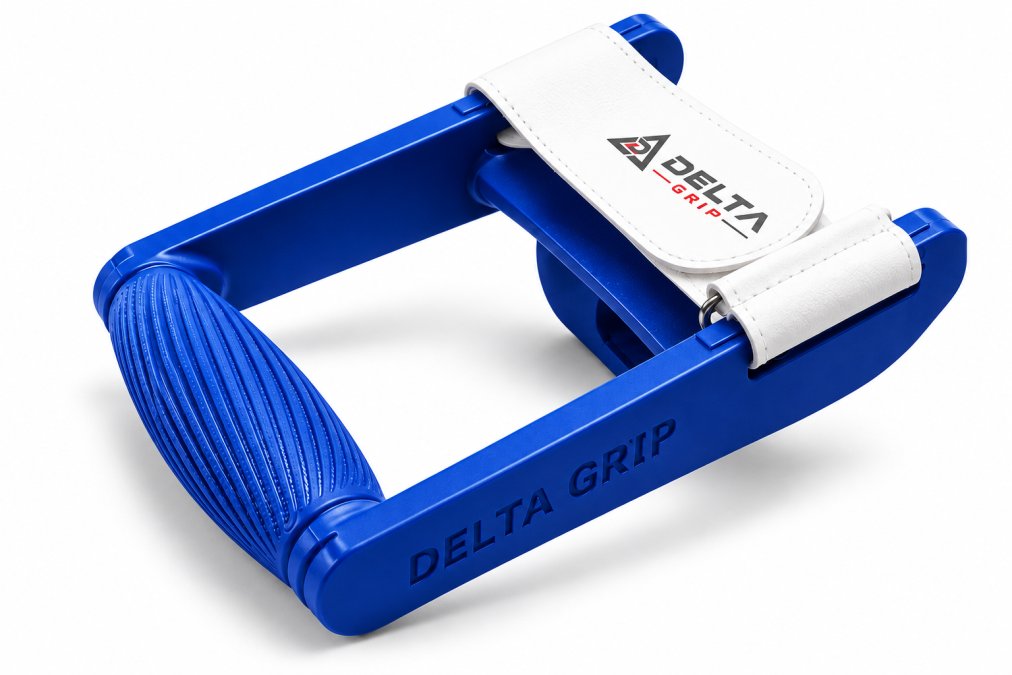
The fix is a handle that locks your wrist in a neutral position and moves the load toward the forearm. That's the design behind the Delta Grip cable attachment, and it's why we built it.

Cable Lateral Raise for Side Delts: Setup and Execution
The cable lateral raise is the best single exercise for the lateral head of the deltoid. It builds shoulder width, and cables keep it under tension the entire time.
Cable Height, Starting Position, and Arm Path
Set the pulley at the lowest position. Stand side-on to the machine, grab the handle with the outside hand, and let your arm hang across your body.
- Keep a slight bend in the elbow and hold it there
- Raise the arm out to the side until it reaches shoulder height
- Stop at shoulder height, no higher
The arm path matters more than the load. If the weight swings up, the delt isn't working.
Cable Rear Delt Fly: Hitting the Posterior Shoulder
The rear delt is often neglected by lifters.
Hinge Position and Cross-Body Pull
Set the pulley at shoulder height. Grab the handle with the opposite hand and hinge forward at the hips until your torso is nearly parallel to the floor.
Pull the handle across your body in a wide arc, leading with the elbow. Squeeze at the end range, then return slowly.
Cable Front Raise for Front Delts: Controlled Lifting
The anterior deltoid is the head most lifters already train hard through pressing, so cable front raises work best as a finishing movement rather than a primary builder. The goal here is not load. It is controlling the arm path so the front delt does the work instead of the upper chest, traps, or momentum.
Pulley Height, Stance, and Handle Choice
Set the pulley at the lowest position. Stand facing away from the machine with the cable running between your legs, or face the machine and pull the handle up and forward from a low anchor. Both setups work; the away-facing version keeps more tension at the top of the rep.
- Use a single handle or a straight bar. A single handle lets you rotate the wrist slightly and keeps the arm path cleaner.
- Stand with feet shoulder-width, knees soft, and ribs down. If your lower back arches, the weight is too heavy.
- Grip the handle with a neutral or slightly pronated wrist and keep it locked. A wrist that rolls forward pulls the forearm into the rep.
Arm Path and Range of Motion
Raise the handle forward and slightly across the midline until the hand reaches about eye level or shoulder height. Going higher shifts the work to the traps and the front of the neck.
- Keep a slight, fixed bend in the elbow. Do not let the elbow flex and extend through the rep; that turns it into a curl.
- Lead with the elbow, not the hand. The hand just holds the handle.
- Stop at shoulder height. Anything above that is trap work.
- Lower under control over two to three seconds. The lowering phase is where most of the stimulus lives.
How This Fits With the Other Two Heads
Treat the front raise as the third priority in a cable delt session. Most lifters get plenty of anterior delt work from bench pressing, overhead pressing, and incline work, so one or two sets at the end is usually enough.
For demonstrations of the front raise and the other cable delt movements, see the Exercise Guide tab on our site.
Cable Lateral Raise Mistakes That Kill Delt Isolation
Most cable lateral raise mistakes come down to one thing: the wrong muscle is doing the work. The lateral head is small, and it will hand the job off to the traps, the upper back, or the forearm the moment the setup or the rep breaks down. Here is how to spot each handoff and fix it.
Troubleshooting: When Traps or Arms Take Over
If your traps burn first, you are shrugging the weight up instead of raising the arm. Drop the load by about 20 percent and think about pushing the elbow out and away from your body, not lifting the hand.
The Delta Grip Gym Cable Pulley Lateral Raise Attachment →
If your forearms and hands give out first, that is a grip problem, not a delt problem. Our Delta Grip is built for exactly this, and it lets you keep the tension on the lateral head instead of ending the set when your grip quits.
Elbow Position and Torso Lean
A bent elbow that opens and closes through the rep turns the movement into a row. Set the elbow at a slight, fixed bend before the first rep and do not change it.
Leaning the torso away from the machine can add range at the bottom, but leaning back and swinging the torso into the rep is momentum, not isolation.
Cable Height and Range of Motion
Setting the pulley too high shortens the bottom of the range and puts the shoulder in a position where the traps want to take over. Keep the pulley at the lowest setting for lateral raises.
Lower the handle all the way back to the starting position under control. Cutting the bottom half of the rep is one of the most common ways lifters lose tension on the lateral head.
Self-Checks: Is the Lateral Head Actually Working?
You cannot see your own lateral delt mid-rep, so use these checks.
- Touch the muscle. Put your free hand on the side of the working shoulder. You should feel it harden as the arm rises.
- Slow the lowering phase. If the muscle is not working, a three-second lower exposes it fast.
- Check where the burn is. Lateral raises should burn on the side of the shoulder, not the top of the trap or the front of the neck.
- Watch the wrist. A neutral, locked wrist keeps the load on the target muscle instead of your grip.
For demonstrations of the lateral raise and the other cable delt movements, see the Exercise Guide tab. If you want to see how the wrist-locking design keeps the load on the target muscle, visit https://thedeltagrip.com.
Load, Reps, Tempo, and Progression for Cable Delt Isolation
Start lighter than you think you need. Isolation work rewards control, not ego.
| Phase | Load | Reps | Tempo |
|---|---|---|---|
| Learn the pattern | Light | 12-15 | 2 sec up, 3 sec down |
| Build volume | Moderate | 10-15 | 1 sec up, 3 sec down |
| Push progression | Heavier | 8-12 | 1 sec up, 2 sec down |
Add weight only when you can complete every rep with the same form. Two to three sets per head, two to three times per week, is plenty.
Cable Setup Options for Different Gym Layouts
Not every gym has the same cable setup. Here's how to adapt.
- Single adjustable pulley: Do everything one arm at a time. Set the height for each movement.
- Functional trainer: Use both stacks for cross-body work and rear delt flys.
- Low row station: Works for front raises and lateral raises with a low pulley.
- Cable crossover: Best option for rear delt flys and cross-body pulls.
If the cable height is fixed, adjust your body position instead. Stand further away to change the angle.
How to Verify the Target Delt Head Is Doing the Work
You can't see your own rear delt in the mirror, so use these checks instead.
- Touch the muscle. Put your free hand on the working delt head. You should feel it harden as you move.
- Slow the rep down. If the muscle isn't working, slowing down exposes it fast.
- Check the burn location. Lateral raises should burn on the side, not the top of the shoulder.
- Watch the wrist. A neutral, locked wrist keeps the load on the target muscle instead of your grip.
Frequently Asked Questions
How do you isolate your delts with cables?
Set the pulley at the right height for each delt head, use a slight elbow bend, and move only at the shoulder joint. For side delts, stand sideways to the cable and raise your arm to shoulder height. For rear delts, hinge forward and pull the cable apart. For front delts, face away and raise the cable forward. Keeping your wrist neutral with a tool like Delta Grip helps transfer load to the forearm so your grip does not give out before your delts do.
Why do I feel cable lateral raises in my traps?
Your traps take over when you shrug the weight up instead of raising your arm. Keep your shoulder pressed down away from your ear throughout the rep. Lower the weight if needed. Also check your cable height: if the pulley is too low, you may pull upward with your traps rather than out to the side. A slight forward lean and a focus on pushing the cable away from your body can help shift tension back to the lateral deltoid.
Can cable exercises train all three heads of the deltoid?
Yes. Cable lateral raises target the lateral head, cable rear delt flys hit the posterior head, and cable front raises work the anterior head. Because cables provide constant tension, you can isolate each head through its full range of motion. Using a wrist-locking attachment like Delta Grip reduces grip fatigue so you can complete enough volume on each head without your hands failing first. Check our Exercise Guide tab for demonstrations of each movement.
How many sets and reps should you do for cable delt isolation?
Most lifters do well with 3 to 4 sets of 12 to 20 reps per delt head. Keep rest periods around 60 to 90 seconds. Use a tempo of two seconds up and three seconds down to maximize time under tension. Increase weight only when you can complete all sets at the top of the rep range with clean form. Because cables keep tension at the bottom of the movement, lighter loads often feel harder than expected.
Most lifters never fully isolate their delts because their grip quits first. The Delta Grip fixes that with a wrist-locking design that moves load to the forearm, an open frame for a natural range of motion, and a stable platform made in the USA. It works across shoulders, chest, back, and triceps, not just lateral raises. Visit thedeltagrip.com and check the Exercise Guide tab for demonstrations and setup instructions before your next session.