

Table of Contents
- Why Attachment Choice Matters for Chest Isolation
- Cable Chest Fly Attachments: Finding the Right Handle
- Best Handle for Cable Flyes: D-Handles, Straight Bars, and Rope
- Cable Chest Isolation Exercises: Technique and Setup
- Single-Arm Cable Chest Fly: Unilateral Benefits and Setup
- How Attachment Design Affects Load Transfer and Tension
- Selecting the Right Attachment for Your Training Goals
- Frequently Asked Questions
Last Updated: October 21, 2026
Why Attachment Choice Matters for Chest Isolation
The cable attachment you choose fundamentally changes how your chest engages during every rep, which is why finding the best cable attachments for chest isolation matters so much. Most lifters grab whatever handle is on the machine and call it a day. That's where the problem starts.
When you're chasing serious chest development, attachment choice isn't a minor detail, it's the difference between hitting your pectorals hard and letting your grip, wrists, or stabilizer muscles steal the work.
At The Delta Grip, we understand how attachment design affects muscle tension and load distribution. A straight bar forces your wrist into extension. A D-handle creates an awkward angle. A rope allows your hands to rotate naturally.
Cable Chest Fly Attachments: Finding the Right Handle
Cable chest fly attachments come down to one core decision: single handle or dual cable setup. That choice determines everything else about your movement pattern and muscle engagement.
Single-Handle vs. Dual-Cable Setup
A single-handle attachment, like a D-handle or straight bar, forces both sides of your body to work in unison. Your left and right sides move together as one unit. This creates bilateral stability and lets you load heavier, but it also means any strength imbalance between sides gets masked.
A dual-cable setup, where each hand holds its own attachment, forces each side to work independently. Your weaker side can't hide behind your stronger side. This unilateral approach builds balanced strength and catches asymmetries early.
For chest flyes specifically, dual-cable setups with individual handles let you control your range of motion more precisely. The trade-off is that you can't load as heavy, so your grip and forearm fatigue faster, which is exactly where a wrist-locking attachment like the Delta Grip becomes valuable.
Handle Shape and Grip Comfort
The shape of your handle directly affects wrist position and comfort during high-volume work. A straight bar keeps your hands in a neutral grip, but it can force your wrists into extension if you're not careful, especially under fatigue.
Rope attachments let your hands rotate freely, which feels natural but introduces instability, your grip has to work harder to maintain control. This is the common mistake: lifters choose rope because it "feels good," but that good feeling often comes from their grip doing extra work, not their chest.
The real win is an attachment that lets your wrist stay neutral without requiring constant muscular tension to hold position. That's where your chest can actually relax into the contraction instead of fighting handle geometry.
Best Handle for Cable Flyes: D-Handles, Straight Bars, and Rope
Each attachment type has a specific role in your training. Knowing when to use each one separates focused training from random handle-swapping.
D-Handle Attachment
D-handles are the workhorse for cable chest isolation. The curved design fits naturally in your palm, and the handle angle encourages a slight internal rotation at the shoulder.
D-handles work best for controlled, moderate-weight flyes where your focus is on the squeeze and constant tension. They're forgiving on the wrist and let you maintain a consistent grip angle throughout your set. The downside: they don't lock your wrist, so grip fatigue can still accumulate during high-volume sessions.
D-handles can be used for isolation work where the weight is secondary to the mind-muscle connection. You're not trying to move the heaviest load, you're trying to feel your chest working through a full range of motion.
Straight Bar Attachment
Straight bars force your hands into a neutral, parallel grip. This creates a strong mechanical advantage and lets you load heavier than D-handles. For lifters who want to drive more absolute tension through their chest, straight bars deliver.
The catch: straight bars put your wrists in a more extended position, especially as you fatigue. Your forearms and grip start working harder to stabilize the bar, which pulls focus away from your chest. This is why straight bars shine for lower-rep, higher-load work, 3 to 6 reps where you're building strength, not chasing the pump.
For high-volume chest isolation work (10+ reps), straight bars become problematic because grip endurance becomes the limiting factor before your chest is truly fatigued.
Rope Attachment
Rope attachments offer maximum hand freedom. Your wrists can rotate, your hands can move independently, and there's no forcing your grip into any specific position. This feels natural and comfortable, which is why many lifters reach for rope first.
Because rope is unstable, your grip muscles have to work overtime to keep the ends from rotating in your hands. Your forearms are firing hard, your hands are gripping tight, and your chest is getting less of the total tension. Rope is best used for very light, high-rep pump work where the instability actually serves your goal, maximum metabolic stress with minimal joint stress.
For serious chest isolation, rope may not be the optimal choice unless you're specifically training grip endurance as a secondary goal.
Cable Chest Isolation Exercises: Technique and Setup
Isolation isn't just about the attachment, it's about how you use it. The same attachment can feel like a chest exercise or a shoulder exercise depending on your setup and execution.
High-to-Low Cable Fly
High-to-low flyes target the lower chest fibers by pulling the cable down and across your body. Your pulleys start at shoulder height or slightly above, and you finish with your hands meeting at waist level or below.
The setup matters: stand in the middle of the cable station with your feet shoulder-width apart. Grab one handle in each hand (or use a single attachment if you prefer bilateral work). Your elbows should stay slightly bent, not locked straight, not overly bent.
The most common mistake is letting your shoulders do the work. If your shoulders are rising toward your ears or your upper back is rounding, you've lost chest tension. Keep your chest up, shoulders back, and focus on the lower pectoral contraction at the bottom of the movement.
Low-to-High Cable Fly
Low-to-high flyes reverse the angle, targeting the upper chest by pulling the cable upward and across. Your pulleys start low (near knee height), and you finish with your hands meeting at upper-chest level.
This movement demands more shoulder stability because you're fighting gravity in the opposite direction. Your core has to stay tight, and your chest needs to stay proud. Many lifters lean back too far, turning this into a shoulder press instead of a chest isolation exercise.
The key: keep a slight forward lean if anything, but let your chest do the pulling, not your shoulders. Your elbows stay bent at roughly 90 degrees throughout, and the movement is smooth and controlled, not explosive.
Cable Crossover
Cable crossovers combine both angles in one movement. You start with your arms out to the sides (high-to-low position) and finish with your hands crossed in front of your body (or at chest level, depending on your preference).
This is where constant tension really shines. Unlike dumbbells, where tension drops at the top of the movement, cables maintain resistance throughout the entire range. Your chest is working hard at the start, the middle, and the finish.
Setup: stand in the center of the cable station, grab both handles, and step forward slightly so there's tension even with your arms spread wide. As you pull, your hands travel in a smooth arc toward the center line of your body. Finish with a hard chest squeeze, then control the weight back to the start.
Single-Arm Cable Chest Fly: Unilateral Benefits and Setup
Single-arm work forces each side of your chest to carry its own load. This is where imbalances become obvious, and where serious lifters build balanced development.
With a single-arm cable fly, your non-working side has to stabilize your entire torso against rotation. Your core is engaged, your obliques are firing, and your working-side chest is under maximum tension. You can't cheat. You can't compensate.
The setup is simple: stand perpendicular to the cable station with the pulley at chest height. Grab the handle with one arm, step away to create tension, and perform your fly. Your body wants to rotate toward the cable, resist that.
Most lifters underestimate how much harder single-arm work is. You'll likely use less weight than bilateral work, and that's exactly the point. The goal is balanced strength and maximum isolation, not ego lifting.
How Attachment Design Affects Load Transfer and Tension
This is where the real difference between attachments becomes clear: how they transfer tension to your target muscle versus your grip and forearms.
A standard cable handle requires your grip to maintain position throughout the set. As you fatigue, your forearms work harder to hold the handle stable.
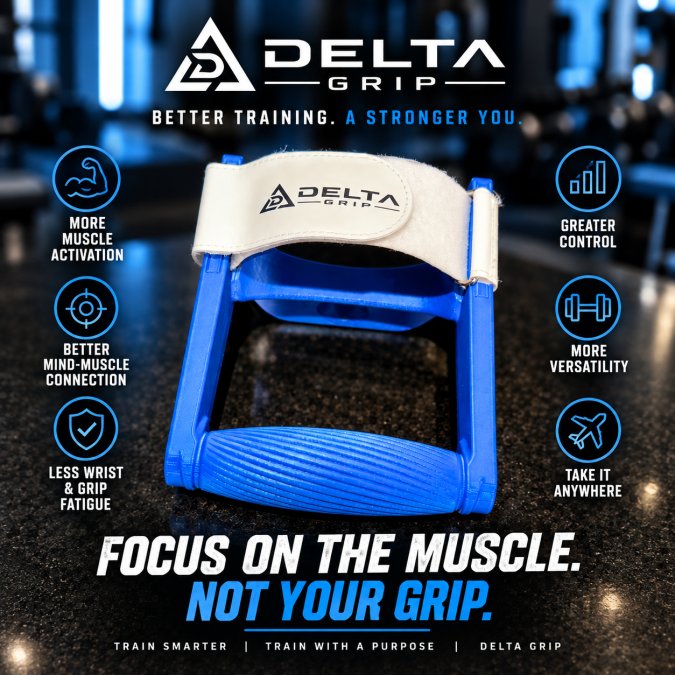
A wrist-locking attachment like the Delta Grip changes this equation. By securing your wrist in a neutral position, the attachment transfers tension directly to your forearm, bypassing your grip entirely. Your hands aren't fighting to maintain position.
This matters most during high-volume work. On a single set of 8 reps, the difference might be subtle.
The constant tension principle, that cables maintain resistance throughout your range of motion, becomes even more powerful when your grip isn't fatiguing. You're not fighting the handle. You're not adjusting your hand position mid-set.
Selecting the Right Attachment for Your Training Goals
Your training goal should dictate your attachment choice. There's no single "best" attachment, there's only the best attachment for what you're trying to accomplish today.
If your goal is strength building with heavy load, a straight bar lets you handle more weight, but expect your grip to fatigue faster.
If your goal is metabolic stress and the pump, rope attachments create instability that increases time under tension.
For most serious lifters, the best approach is mixing attachments across your week. Heavy bilateral work with a straight bar on day one.
The Delta Grip fits naturally into this rotation.
Visit our Exercise Guide tab at thedeltagrip.com to see demonstrations of how the Delta Grip performs across high-to-low flyes, low-to-high flyes, and cable crossovers.
The difference between good chest isolation and great chest isolation often comes down to details. Get started with the Delta Grip and experience how attachment design changes your chest training at thedeltagrip.com.
Frequently Asked Questions
Which cable attachments are best for chest isolation?
D-handles, straight bars, and rope attachments each serve different isolation goals. D-handles allow unilateral work and natural wrist positioning; straight bars support bilateral presses and flies with consistent load distribution; rope attachments enable a wider range of motion and hand positioning. Your choice depends on the exercise, your comfort, and whether you're targeting one side or both. For maximum chest tension with reduced grip demand, wrist-neutral designs like the Delta Grip help you focus load on the pectorals rather than fighting to maintain your grip.
How does wrist-neutral cable attachment design improve chest focus?
A neutral wrist position reduces the demand on your grip and forearm muscles, allowing you to direct more tension toward your chest. Standard handles often require wrist flexion or extension to maintain contact, which diverts energy away from your target muscle. By locking your wrist in a stable, neutral position, attachments like the Delta Grip transfer load toward the forearm and away from your grip, letting you achieve stronger contractions and better mind-muscle connection with the pectorals during cable flies and presses.
Can you really isolate the chest with cable machines?
Yes. Cable machines provide constant tension throughout the range of motion, which dumbbells and barbells cannot match. Proper attachment choice, pulley height, body position, and exercise selection all determine how well you isolate the chest. Single-arm cable flyes and crossovers are particularly effective for isolation because they allow unilateral movement and a controlled squeeze. The key is selecting an attachment that doesn't force your wrist or grip into compensation patterns, so tension stays on the pectoralis major and minor.
What's the difference between high-to-low and low-to-high cable flyes for the chest?
High-to-low flyes emphasize the lower and middle chest fibers, creating a downward line of pull that mimics a pressing motion. Low-to-high flyes target the upper and middle chest, with an upward line of pull. Both deliver constant tension and chest isolation when performed with proper form and the right attachment. Switching between them throughout your training cycle allows you to hit all chest fibers and break through plateaus. The attachment you choose should support a comfortable, stable grip so you can focus on the movement and the squeeze, not on holding on.