

Table of Contents
- Why Grip Fatigue Limits Your Cable Training
- Cable Exercises for Shoulders: Isolation Setup and Technique
- Cable Chest Isolation Exercises: Controlling the Line of Pull
- Cable Back Isolation Exercises: Single-Arm and Unilateral Work
- Cable Triceps Isolation Exercises: Eliminating Momentum
- Improving Muscle Isolation on Cable Machines: Core Setup Principles
- Troubleshooting Common Compensation Patterns
- Programming Isolation Work for Consistent Progress
- Frequently Asked Questions
Last Updated: October 11, 2026
Why Grip Fatigue Limits Your Cable Training
Grip fatigue is one of the most underrated limiting factors in cable machine training.
Most lifters accept this trade-off without questioning it. They load up a cable machine, grab a standard handle, and watch their forearms fail long before their pecs or delts reach true fatigue.
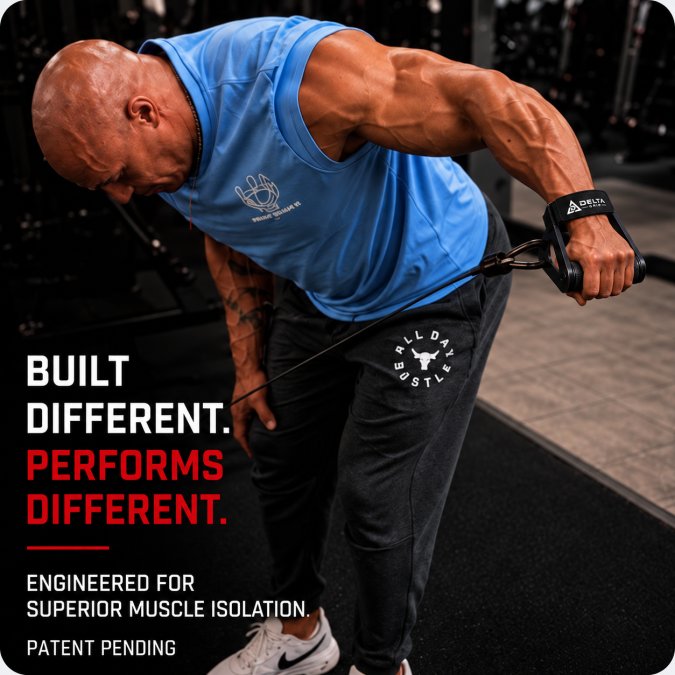
The Delta Grip addresses this directly. By locking your wrist in a neutral position, it transfers load away from your grip and toward your forearm, allowing you to focus entirely on the target muscle.

Cable Exercises for Shoulders: Isolation Setup and Technique
Shoulder isolation on cable machines demands precision in body position and handle selection. The cable provides a unique advantage: resistance follows a straight line from the pulley, not a curved path like dumbbells. Understanding this resistance vector is critical for true isolation.
Lateral Raises and Front Raises
Lateral raises on the cable machine isolate the middle deltoid more effectively than most free-weight variations because the resistance stays perpendicular to your body throughout the movement. Set the pulley at hip height and stand perpendicular to the machine.
Front raises target the anterior deltoid with similar precision. Position yourself facing the machine with the pulley at hip height. Lift your elbow to shoulder height, not your arm. Control the eccentric phase for 2-3 seconds per rep to improve mind-muscle connection and prevent momentum.
Face Pulls and Rear Delt Flyes
Face pulls require attention to setup. Position the pulley at upper-chest height, grab a rope or split cable attachment, and pull toward your face while flaring your elbows.
Rear delt flyes work best with the pulley set at shoulder height. Keep a slight bend in your elbows and focus on spreading your shoulder blades apart at the top of the movement. This variation builds the rear deltoid and improves shoulder stability.
Cable Chest Isolation Exercises: Controlling the Line of Pull
The chest responds exceptionally well to cable machines because the resistance remains constant throughout the range of motion. Understanding how the line of pull affects which part of the pectoralis major is engaged is essential for effective isolation.
Cable Flyes and Crossovers
Cable flyes are the gold standard for pectoral isolation. Set both pulleys at mid-chest height and stand in the center of the machine. Avoid standing too close or positioning your hands too high, which shifts tension to the anterior deltoid.
High-to-low cable flyes target the lower pectoralis major by creating greater stretch at the bottom and intense contraction at the top. Low-to-high flyes emphasize the upper chest. Both variations improve muscle isolation by changing the resistance vector.
High-to-Low and Low-to-High Variations
When the pulley is high and you pull low, you target the lower chest with constant tension throughout the movement. Low-to-high cable work reverses this, emphasizing upper pectoral fibers. Incorporating both angles ensures comprehensive chest development.
Cable Back Isolation Exercises: Single-Arm and Unilateral Work
Back isolation improves dramatically with single-arm and unilateral movements. These variations force each side to work independently, eliminating compensation with your stronger side, and allow greater range of motion than many barbell movements.
Single-Arm Rows and High Rows
Single-arm cable rows are one of the most underrated back-building exercises. Set the pulley at mid-chest height and stand perpendicular to the machine. Drive your elbow back rather than pulling your hand forward, this ensures your back does the work, not your arm.
High rows target the upper back and rear deltoid. Set the pulley at shoulder height and pull toward your collarbone or upper chest, keeping your elbow high. This builds the upper trapezius and posterior deltoid while improving posture and shoulder stability.
Pullovers and Straight-Arm Pulldowns
Cable pullovers work the chest and back simultaneously. Set the pulley at upper-chest height, grab a straight bar or rope, and pull downward in an arc, keeping your arms mostly straight. This variation improves muscle isolation across the entire torso.
Straight-arm pulldowns emphasize the lats and lower back. Set the pulley high, keep your arms nearly straight, and pull downward in a controlled arc. Avoid elbow flexion, significant bending shifts the exercise from lat isolation to lat pulldown.
Cable Triceps Isolation Exercises: Eliminating Momentum
Triceps isolation on cable machines is where grip fatigue becomes most obvious. Your hands and forearms tire quickly on standard handles, preventing your triceps from reaching true fatigue. This is where improving muscle isolation on cable machines becomes personal: your triceps deserve to work without your grip being the limiting factor.
Pushdowns and Rope Variations
Tricep pushdowns are the foundation of cable triceps work. Set the pulley at upper-chest height and push downward, extending your elbows fully. Avoid momentum and elbow drift, true isolation requires a stable torso and controlled movement.
Rope variations allow greater range of motion and reduce wrist strain by allowing natural wrist rotation. Splitting the rope at the bottom increases stretch and contraction. For improving muscle isolation, rope pushdowns are often superior to bar variations.
The Delta Grip Gym Cable Pulley Lateral Raise Attachment →
Overhead Extensions and Single-Arm Work
Overhead triceps extensions provide intense stretch and contraction. Set the pulley at shoulder height or slightly above, grab the handle with both hands, and position it behind your head. Extend your elbows forward and upward, keeping your upper arms nearly vertical.
Single-arm overhead extensions force each triceps to work independently and prevent compensation. The unilateral nature also increases core demand as you resist rotation and maintain a stable torso.
Improving Muscle Isolation on Cable Machines: Core Setup Principles
The foundation of improving muscle isolation on cable machines rests on three variables: pulley height, body position, and resistance vector. Master these, and every cable exercise becomes more effective. Ignore them, and you're leaving isolation gains on the table.
Pulley Height and Body Position
Pulley height determines the angle of resistance relative to your body. A pulley at hip height creates a horizontal line of pull; at shoulder height, a different vector; at upper-chest height, yet another. Each angle targets different muscle fibers.
Range of Motion and Resistance Vector
Range of motion on cable machines is often greater than most free-weight movements. Maximize stretch at the beginning and full contraction at the end to increase time under tension and improve hypertrophy stimulus. The resistance vector determines which muscle fibers are emphasized, a high-to-low pull targets the lower chest differently than a low-to-high pull.
Attachment Selection and Load Transfer
The attachment you choose fundamentally changes how the load is distributed. Standard handles force your grip to bear significant load, limiting target muscle tension. The Delta Grip transfers this load toward your forearm by locking your wrist in a neutral position, allowing your target muscle to work harder without grip limitation. Rope attachments provide flexibility in wrist position; D-handles offer stability for unilateral work.
Troubleshooting Common Compensation Patterns
Even with perfect setup, compensation patterns emerge under fatigue. Recognizing and correcting these patterns is essential for maintaining isolation and preventing injury.
Momentum and Swing
Momentum is the most obvious compensation. Your body swings the weight rather than your muscle contracting to move it. Reduce weight and focus on controlled movement, a lighter weight moved with perfect control builds more muscle than a heavy weight moved with momentum. Watch your torso during cable work; if your chest, shoulders, or hips are moving to assist, momentum has taken over.
Grip Fatigue Masking Target Muscle Work
This is the core problem improving muscle isolation on cable machines addresses. Your grip fails before your target muscle reaches true fatigue. You stop the set thinking your muscle is done, but it still has reps left.
The Delta Grip eliminates this problem by transferring load away from your grip. Your hands stay neutral and stable, allowing your target muscle to work to true fatigue.
Body English and Secondary Muscle Involvement
Body English, using your torso, hips, or legs to assist the movement, is a subtle compensation that shifts load away from your target muscle. Prevent this by anchoring your feet, bracing your core, and maintaining a neutral spine. Film yourself from the side to catch these patterns.
Programming Isolation Work for Consistent Progress
Include 2-3 isolation exercises per muscle group per week, performed after compound movements when your muscles are already primed. Cable exercises are ideal because they provide constant tension and allow controlled, high-quality reps.
Improving muscle isolation on cable machines requires you to eliminate the variables that limit your target muscle from working hard. Grip fatigue is one of those variables, and it's one you can control.
Frequently Asked Questions
How do you isolate a muscle on a cable machine?
Isolate a muscle by controlling three variables: position your body to eliminate momentum, set the pulley height so the resistance vector matches the muscle's line of pull, and select an attachment that allows your target muscle to work without grip interference. Slow, controlled movement with a full range of motion ensures the target muscle bears the load. Focus on the mind-muscle connection by pausing briefly at peak contraction.
What cable attachment is best for muscle isolation?
The best attachment transfers load away from your wrist and grip to your forearm, allowing your target muscle to work without fatigue limiting your set. The Delta Grip is engineered with a wrist-locking design that does exactly this, enabling heavier lifts and stronger contractions on shoulders, chest, back, and triceps. Rope handles work well for triceps; single handles suit unilateral work; bars suit bilateral pressing and pulling movements.
How can I stop my grip from limiting cable exercises?
Your grip shouldn't be the weak point on cable isolation work. If your grip gives out before your target muscle is fatigued, you're losing reps and tension. Using an attachment like the Delta Grip that locks your wrist neutral and transfers the load to your forearm solves this problem, allowing you to focus entirely on target muscle tension and mind-muscle connection without wrist or hand discomfort.
Which cable exercises isolate the shoulders, chest, back, and triceps best?
Shoulders: lateral raises, front raises, face pulls, and rear delt flyes. Chest: cable flyes, crossovers, and high-to-low variations. Back: single-arm rows, high rows, pullovers, and straight-arm pulldowns. Triceps: rope pushdowns, overhead extensions, and single-arm work. Each movement should be performed with controlled tempo, proper pulley height, and an attachment that keeps tension on the target muscle throughout the range of motion.
How do you set cable height for different muscle groups?
Pulley height determines the resistance vector. For shoulders, set the pulley at shoulder height for lateral raises or slightly below for front raises. For chest flyes, position pulleys at mid-chest height. For back rows, set them at mid-back height. For triceps pushdowns, position pulleys at or slightly above shoulder height. Adjust based on your body position and the line of pull that best matches the muscle's natural movement pattern.
Are cable machines good for isolating muscles?
Cable machines excel at isolation work because the resistance is constant throughout the range of motion, and you can adjust the resistance vector by changing pulley height and body position. Unlike free weights, cables maintain tension on the target muscle from start to finish. They also allow single-arm and unilateral training, which builds balanced strength and forces each side to work independently without compensation.
How many sets and reps should I do for cable isolation exercises?
For muscle hypertrophy, perform 3 to 4 sets of 8 to 12 reps per exercise, focusing on controlled movement and target muscle tension. Higher rep ranges work well for isolation because they reduce reliance on heavy load and let you emphasize the mind-muscle connection. Rest 60 to 90 seconds between sets. Adjust volume based on your training experience and recovery capacity; beginners may start with 2 to 3 sets.