

Table of Contents
- Why Grip Fatigue Hits Before Your Back Does
- Neutral-Grip Cable Row Form: Setup That Saves Your Grip
- How to Hold a Close-Grip Cable Row Handle
- Cable Row Attachments for Grip: Which Handle Reduces Fatigue
- Lifting Straps for Cable Rows: How to Use Them Without Losing Form
- Grip-Strength and Forearm Training Outside Cable Rows
- When Grip Fatigue Is a Warning Sign
- Conclusion
- Frequently Asked Questions
Last Updated: October 16, 2026
Why Grip Fatigue Hits Before Your Back Does
Grip fatigue during cable rows is when your hands and forearms quit long before your back gets a real workout.
In a cable row, your lats, rhomboids, and mid-back can move serious load. Your fingers, wrists, and forearms are the link between that strength and the handle.
At The Delta Grip, we build cable attachments around one idea: the wrist should not be the weak point in the chain.
The Weak Link in the Chain
Your forearms do two jobs during a row: hold the handle and help pull. That double duty burns them out fast.
Here is what most lifters feel:
- The first few reps feel strong and controlled
- Around rep eight, the hands start to slip or cramp
- The back still has plenty left, but the set ends anyway
A common mistake is blaming weak back muscles. Usually the back is fine, the grip just ran out of gas first.
Neutral-Grip Cable Row Form: Setup That Saves Your Grip
Good neutral-grip cable row form starts with your wrist position, not your pulling power. A straight, neutral wrist lets the load travel through the forearm instead of hanging off the hand.
Here is how we set up:
- Sit tall with your chest up and shoulders set back
- Keep a slight bend in your knees
- Grip the handle so your palms face each other
Starting Position and Posture
Sit with your feet planted and your spine tall, and keep your shoulder blades down and back before the first rep. Do not round your shoulders forward, that pulls the handle out of line and forces your hands to work harder.
Pulling Path and Torso Position
Pull the handle toward your lower ribs, keeping the path smooth and close to your body. Limit how far you lean back, heaving the weight with your whole torso turns a back exercise into a grip contest. Control the return phase too; jerking and bouncing spike the load on your hands.
How to Hold a Close-Grip Cable Row Handle
Learning how to hold a close-grip cable row handle comes down to one rule: let the handle sit in your fingers, not your palm.
A few cues we give athletes:
- Wrap your fingers around the handle without squeezing hard
- Keep your wrists in line with your forearms
- Relax your grip between reps instead of death-gripping
Squeezing the handle as hard as you can feels strong, but it drains your forearms fast. A relaxed but secure hold lasts longer. Close grip keeps your elbows tucked and your wrists straighter; a wide grip can twist the wrist and add strain.
Cable Row Attachments for Grip: Which Handle Reduces Fatigue
The attachment you choose changes how much your hands have to work. Here is how the common options compare:
| Attachment | Grip Demand | Wrist Position | Best For |
|---|---|---|---|
| Standard straight bar | High | Fixed, can twist | Light rows |
| V-bar / close neutral | Moderate | Neutral | Most back work |
| Wide bar | High | Turned out | Variety, not grip |
| Single D-handle | Moderate | Varies per side | Unilateral rows |
| Wrist-locking frame | Low | Locked neutral | High-volume sessions |
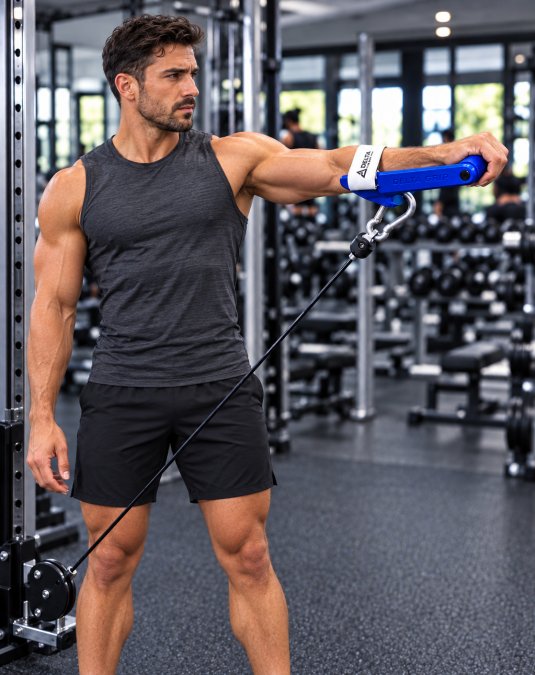
A handle that locks your wrist in a neutral position takes the load off your hands and moves it toward your forearm. That is the design behind the Delta Grip. The open frame lets your wrist stay straight through the full range of motion, so your grip is not fighting the handle on every rep.
If you want to see how this fits your training, our Exercise Guide tab has demonstrations and usage instructions.
Lifting Straps for Cable Rows: How to Use Them Without Losing Form
Lifting straps for cable rows work best when you treat them as a tool with a specific job: they route the load around your fingers and into your wrist so your back can keep working after your grip would normally quit.
What Straps Actually Do
A strap is a short length of webbing that loops over the handle and around your wrist. When you pull, the webbing tightens and the handle hangs from the strap rather than from your finger flexors. Your fingers still close around the handle, but they are no longer the primary link in the chain, which is why straps let most lifters add reps on back work without their hands giving out first.
How to Attach Them
- Loop the strap over the handle so the tail hangs toward the floor.
- Slide your hand through the loop and let the strap sit just below the wrist crease, on the meaty part of the forearm.
- Twist the handle once so the strap wraps over itself and cinches down.
- Grip the handle normally, fingers wrapped, thumb around, wrist straight.
- Pull. The strap should tighten on its own within the first inch of travel.
If the strap slides onto your palm or pinches the wrist bones, the fit is off. Snug, not tourniquet-tight, is the target.
When to Strap In, and When Not To
A simple decision rule we use:
- Strap in when grip is the limiter and your back still has reps left. If your last set of rows ends because your hands open, not because your lats stop firing, straps are the right call.
- Strap in for high-volume back days, drop sets, and any session where you are chasing total back work rather than grip work.
- Skip the straps for at least one or two sets per session so your hands still get exposed to load. Grip is a trainable quality, and if you strap every set of every pull, you never give it a reason to improve.
The Form Risk Nobody Warns You About
Straps do not create bad form, but they mute a feedback signal that keeps form honest. When your grip is fresh and the weight is heavy, your hands tell you when you are about to lose position. Without that signal, some lifters lean back further, shrug higher, and let the torso do work the mid-back should be doing. The fix: after you strap in, run the same checklist you would without them, chest up, shoulder blades set down and back, handle traveling to the lower ribs, torso lean limited to a slight rock, controlled return.
Straps vs. a Wrist-Locking Handle
Straps and a wrist-locking attachment solve overlapping but different problems. Straps bypass the fingers; a wrist-locking frame like the Delta Grip keeps the wrist neutral and straight so the load travels through the forearm instead of hanging off a bent wrist. Many lifters use both, the handle keeps the wrist aligned, and the strap handles the finger side. The Exercise Guide tab has demonstrations and usage instructions.
Grip-Strength and Forearm Training Outside Cable Rows
Building grip strength outside the row fixes the root problem instead of working around it every session. If your hands get stronger, they stop quitting first, and your back work stops being capped by your forearms. Here is the plan we give lifters.
Two Kinds of Grip You Need to Train
Grip is not one quality. For cable rows, two matter most:
- Support grip, how long you can hold a loaded handle. This is what fails on rep eight of a row. Dead hangs and farmer carries train it.
- Crush grip, how hard you can squeeze. This matters less for rows but supports most other pulling. Hand grippers and thick-handle holds train it.
If your rows die from your hands opening, support grip is your priority. If your rows die from your hands cramping, crush grip and forearm endurance are usually the bigger lever.
A Simple Weekly Plan
Two sessions per week is enough. More than that and your hands never fully recover, which shows up as worse grip on row day.
Session A, Support Grip
- Dead hangs from a pull-up bar: 3 sets, hold to near-failure, rest 90 seconds
- Farmer carries with heavy dumbbells: 3 sets of 30-40 steps, rest 90 seconds
Session B, Crush and Forearm
- Plate pinches: 3 sets, hold to near-failure per hand
- Wrist curls: 3 sets of 12-15
- Reverse wrist curls: 3 sets of 12-15
That is six to eight working sets per session. Treat it like any other accessory work: add a little load or time each week, and back off when your hands feel beat up.
Progression Rules That Actually Work
- Add time before you add weight on holds. An extra five seconds on a dead hang is a real strength gain.
- Keep carries heavy but short. If you can walk 60 steps without your grip faltering, the dumbbells are too light.
- Do not train grip the day before your heaviest back session. Sore forearms on row day defeat the purpose.
Where This Fits With the Rest of Your Training
Grip work is not the star of the show. It is the support crew for your back, shoulders, chest, and triceps work.
If you want to see how the frame changes your hand position on rows, presses, and pull-downs, the Exercise Guide tab has demonstrations and usage instructions. You can also head to thedeltagrip.com to see how it fits a standard cable station.
When Grip Fatigue Is a Warning Sign
Some grip fatigue is normal. Some is a signal to look closer.
Talk to a qualified professional if you notice:
- Numbness or tingling in your hands or fingers
- Sharp wrist pain during or after rows
- Weakness that does not improve with rest
These signs can point to issues that training alone will not fix. We are not doctors, and we do not treat or diagnose anything. If something feels wrong beyond normal muscle tiredness, get it checked.
Conclusion
Grip fatigue during cable rows is a fixable problem.
The Delta Grip was built for exactly this. Our wrist-locking design transfers load to the forearm, reduces reliance on grip, and helps you focus on the target muscle and the mind-muscle connection.
Head to thedeltagrip.com to add one to your setup, and check the Exercise Guide tab for demos before your next session.
Frequently Asked Questions
How can I stop my grip from giving out during cable rows?
Fix your setup first: chest up, shoulders set, elbows tucked, and wrists straight so the load travels through the forearm instead of the hand. If grip fatigue still cuts your back work short, rotate in a neutral-grip handle, then add lifting straps for your heaviest sets. Training forearms and grip separately two days a week also raises the ceiling so your hands stop being the limiting factor.
Should I use a lighter weight if my hands fatigue during cable rows?
Not automatically. Dropping weight can help you finish a set with clean form, but if grip fatigue is the real problem, lighter loads just delay the same failure. Try a neutral-grip or close-grip attachment, keep the return phase controlled instead of letting the stack pull your arms out, and use straps on top sets. Save the lighter work for back-off sets where you chase muscle focus, not for fixing grip.
Can lifting straps help with grip fatigue during cable rows?
Yes. Straps wrap around the handle and take the holding demand off your fingers, so your lats, mid-back, and rear delts keep working after your hands would normally quit. Use them on heavy or high-repetition sets, keep the strap snug but not tight enough to cut circulation, and still train grip directly so you are not dependent on them for every set.
What muscles do neutral-grip cable rows work?
Neutral-grip cable rows hit the same pulling muscles as any row: lats, rhomboids, mid-traps, rear delts, and biceps, with the forearms working hard to hold the handle. The palms-facing position keeps the wrists stacked and often feels more comfortable than a pronated bar. That comfort matters because a stable wrist lets you focus on the target muscle instead of managing handle discomfort.