

Table of Contents
- Why Your Grip Fails Before Your Target Muscle Does
- What Makes a Cable Attachment Good for Muscle Contraction
- Cable Attachments for Muscle Isolation: What to Look For
- How to Improve Mind-Muscle Connection on Cable Exercises
- Cable Machine Attachments for Shoulders: Getting the Most From Lateral Raises
- Cable Machine Attachments for Triceps: Pressdowns, Extensions, and Control
- How the Delta Grip Changes the Way You Train
- Common Mistakes When Switching Cable Attachments
- Frequently Asked Questions
Last Updated: October 18, 2026
Why Your Grip Fails Before Your Target Muscle Does
Your set ends when your hands quit, not when your chest or delts do. That is the central problem with cable training, and it is the reason so many lifters walk away from a set of cable flyes feeling their forearms instead of their pecs.
At The Delta Grip, we build around a single idea: the wrist should not be the weak link in a cable movement.

Below, we break down what separates a good attachment from a bad one, how to improve mind-muscle connection, and how to pick the right handle for shoulders, chest, back, and triceps. But first, here is what most buying guides get wrong.
What Makes a Cable Attachment Good for Muscle Contraction
A good cable attachment keeps your wrist neutral, matches the path of the movement, and lets you load the target muscle without your hands dictating the rep. Those three qualities matter more than material, finish, or brand name.
A cable attachment is the handle, bar, rope, or specialty grip clipped to a cable stack that connects your hand to the load. The attachment's shape and angle decide how your wrist sits, how far you can move through a range of motion, and how much of the resistance your grip has to manage.
Wrist Position and Load Transfer
Neutral wrist position is the single biggest factor in whether a cable exercise hits the muscle you intended. When your wrist stays stacked in line with your forearm, the load travels through the forearm structure rather than being held by the hand and finger flexors. That shift is what lets you push a set closer to true target-muscle failure.
Fixed straight bars and closed-loop handles often force slight wrist extension or ulnar deviation. Over a high-volume session, that position adds up. An open-frame design that lets the hand sit naturally, with the wrist locked neutral, keeps the load path predictable rep after rep.
Handle Shape and Range of Motion
Handle shape determines how much freedom the joint has to move. A closed handle traps your hand in one orientation, which is fine for pressing but limiting for flyes, lateral raises, and rear delt work where the arm travels through an arc.
An open frame lets the wrist rotate slightly as the arm moves, so the handle follows the natural path of the joint instead of fighting it. That freedom is what allows a fuller range of motion without the handle digging into your palm or pulling your wrist out of line at the top and bottom of the rep.
Cable Attachments for Muscle Isolation: What to Look For
Muscle isolation on a cable stack comes down to removing every point where a weaker joint can take over. The attachment is the first place to look, because it sits between the load and the muscle you are trying to target.
Use this checklist before you buy or swap a handle:
- Does the handle keep your wrist neutral through the full rep, or does it force extension?
- Is the frame open enough that your hand can move naturally at the top and bottom?
- Does the grip width match the movement (narrow for pressdowns, wider for flyes)?
- Can you hold the handle without squeezing hard just to keep it stable?
- Does the attachment stay quiet and stable under load, or does it shift in your hand?
- Is it built to survive shared gym use and high-volume sessions?
If a handle fails the first two items, no amount of cueing will fix the movement. The wrist will win.
How to Improve Mind-Muscle Connection on Cable Exercises
Improving mind-muscle connection on cables starts with reducing the noise your hands create. When your grip is stable and your wrist is locked, you free up attention to feel the target muscle contract, and that attention is what drives a cleaner rep.
Try these cues in your next session:
- Slow the eccentric. Take three to four seconds on the return. Cable tension stays constant, so a slow negative keeps the target muscle loaded the whole way.
- Pause at peak contraction. Hold for a beat where the muscle is shortest. This gives you a clear reference point for what a good contraction feels like.
- Lighten the load first. Drop the weight until you can feel the target muscle working without your grip or wrist taking over. Add load only after the connection is there.
- Watch the set, not the mirror. Look at the working muscle, not your reflection. Attention follows where your eyes go.
- Cut the death grip. Squeeze the handle only as hard as you need to keep it stable. Extra tension in the hand pulls focus away from the target.
Cable Machine Attachments for Shoulders: Getting the Most From Lateral Raises
Cable machine attachments for shoulders matter most on lateral raises, where the delt has to carry the load through a long arc with almost no help from other muscles.
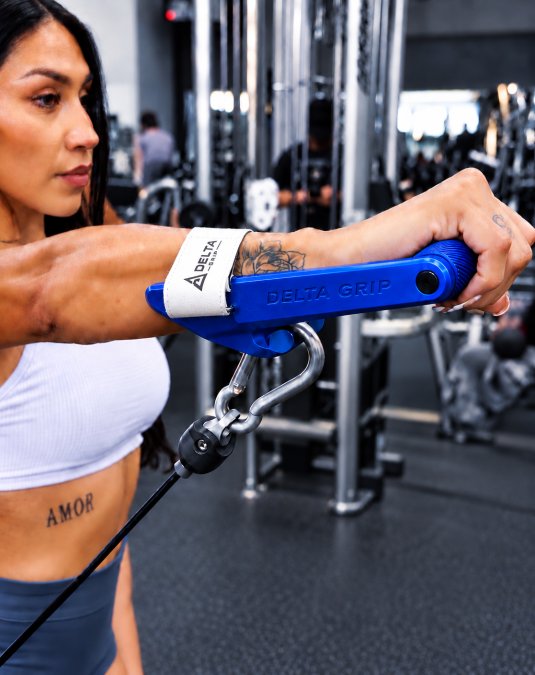
On lateral raises, the cable stays in tension at the bottom of the rep, unlike a dumbbell.
What to look for on shoulder work:
The Delta Grip Gym Cable Pulley Lateral Raise Attachment →
- A handle that lets the wrist stay stacked under the load through the full arc
- Enough openness that the hand can rotate naturally at the top
- A grip you can hold without squeezing hard, so the delt stays the focus
We built the Delta Grip for exactly this pattern. The wrist-locking design holds your wrist neutral and moves the load toward the forearm, which lets you chase a cleaner delt contraction instead of managing a handle.
Cable Machine Attachments for Triceps: Pressdowns, Extensions, and Control
Cable machine attachments for triceps should let you lock the elbow in place and drive the forearm through a controlled range. Rope, straight bar, and single-handles all work, but each one changes how much your wrist has to manage.
On pressdowns, a straight bar keeps both hands fixed, which is efficient but can push the wrist into extension at the bottom. A rope allows a natural spread and a fuller lockout. Single-hand handles give the most freedom but demand more wrist stability per arm.
The control point is the same across all three: if your wrist bends or your grip has to fight the handle, the triceps stop being the limiting factor. An open-frame handle that keeps the wrist neutral lets you drive through the full extension without the hand dictating the rep.
How the Delta Grip Changes the Way You Train
The Delta Grip changes cable training by locking your wrist in a neutral position and transferring load away from the hand and toward the forearm. That single design choice reduces grip and wrist fatigue, which means your sets end when the target muscle is done rather than when your hands give out.
Here is where it fits across muscle groups:
| Muscle Group | Common Cable Move | What the Delta Grip Does |
|---|---|---|
| Shoulders | Lateral raises, front raises | Keeps wrist neutral through the arc so the delt stays loaded |
| Chest | Cable flyes, crossover | Open frame allows a natural path and fuller range |
| Back | Cable rows, pullovers | Reduces grip reliance so the lats carry more of the load |
| Triceps | Pressdowns, overhead extensions | Stable platform for heavier loads with control |
The open frame design allows a natural range of motion, so the handle follows your joint instead of forcing it. The handle is made in the USA, and the patent-pending design is built to hold up to shared gym use and high-volume sessions.
If you are coming from a standard closed handle, expect the first session to feel different. Most lifters notice less forearm burn and more target-muscle tension within a few sets. Give it a week before you judge it.
Common Mistakes When Switching Cable Attachments
Switching attachments goes wrong when lifters change the handle and nothing else. The attachment changes your use, so your load, tempo, and setup usually need to change with it.
The mistakes we see most:
- Keeping the same weight. A neutral-wrist handle can let you move more load with control, but jumping straight to your old number skips the connection work. Start lighter and build.
- Death-gripping the new handle. The point is to reduce grip reliance. If you squeeze harder than before, you cancel the benefit.
- Changing too many variables at once. Swap the attachment, keep the exercise and tempo the same for a few sessions, then adjust.
- Skipping the setup. Handle height and cable angle still matter. A great attachment on a bad setup still produces a bad rep.
- Judging it on one set. The first set feels unfamiliar. Give it a few sessions before you decide.
For exercise demonstrations and setup instructions, check the Exercise Guide tab on our site.
Cable training rewards lifters who remove the weak links, and the attachment is the first link in the chain. If your grip keeps quitting before your target muscle does, the fix may be simpler than adding more forearm work. The Delta Grip is a patent-pending, USA-made cable attachment that locks your wrist neutral, transfers load to the forearm, and lets you focus on the contraction that actually builds the muscle. Browse the full range and get started at thedeltagrip.com, and visit the Exercise Guide tab for demonstrations before your next session.
Frequently Asked Questions
Can a cable attachment help you feel a muscle contract better?
Yes, when the attachment lets you keep a neutral wrist and a stable grip. A standard handle often forces you to squeeze hard just to hold on, so your grip fatigues before the target muscle does. A cable attachment designed to shift load toward the forearm reduces that early grip failure, which lets you put more attention into the contraction itself. The result is not automatic growth, but cleaner tension on the muscle you are trying to train.
How does the Delta Grip work?
The Delta Grip is a cable attachment with a wrist-locking design that holds your wrist in a neutral position. That position moves load away from your hand and wrist and toward your forearm, so you rely less on grip strength during a set. With less grip fatigue, you can focus on the target muscle and the mind-muscle connection. It is made in the USA and fits standard cable setups. See the Exercise Guide tab at https://thedeltagrip.com for demonstrations.
Can you use a cable attachment for shoulders, chest, back, and triceps?
You can use one attachment across several muscle groups if it allows a natural range of motion. For shoulders, cable lateral raises and front raises benefit from a neutral wrist. For chest, cable flyes and presses stay more controlled. For back, rows and pulldowns feel more stable when your grip is not the limiting factor. For triceps, pressdowns and overhead extensions keep tension on the arm. The Delta Grip is built for lateral raises, chest flyes, biceps, triceps, and more.
How do you improve the mind-muscle connection on a cable machine?
Start by removing grip distractions. Use a handle that keeps your wrist neutral so you are not fighting the weight with your hands. Slow the rep down, pause for one second at peak contraction, and keep the tension on rather than letting the stack rest between reps. Use a weight you can control for 10 to 15 reps. Film a set from the side to check that the target muscle, not your lower back or shoulders, is doing the work.